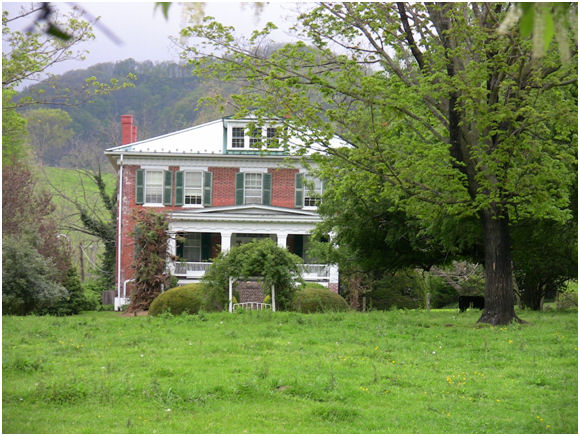
Smithfield
Dr. Smith’s letters show that he
gradually weakened during the early years of the Civil
War. He had
chronic diarrhea, possibly related to the typhoid that
killed so many troops.
In 1862 he rode to the Winchester area to care
for causalities, and died in Lynchburg on the way home.
Dr. John T. Smith is buried three fourths of a
mile west of the Smithfield Mansion.
His favorite horse is buried nearby, as is a
Yankee Ranger who rode up to his house one day, seeking
medical care.
All of Smith’s slaves who died before him are
buried there.
Dr. Smith’s only living child was J. H. A. Smith,
a major of Russell County Confederate volunteers.
His slave, Richmond Long, went through the Civil
War with the major, as his bodyguard.
Richmond’s father had run away from Smithfield,
but had been “recovered”.
Smithfield remains to this day in the family of
Col. Henry Smith, and is an active cattle farm.
