|
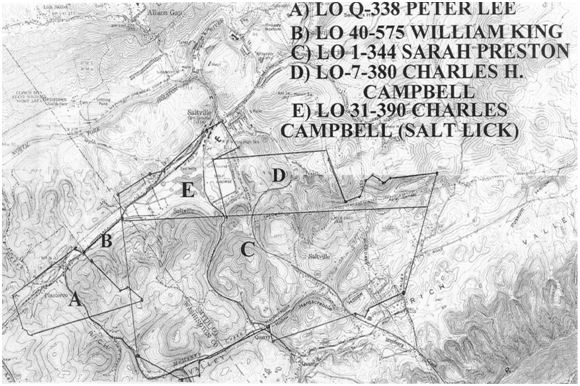
575, which really is the residual of LO
Q-345 not included in LO 1-344.
The issue was negotiated between Preston and King.
The county line between Washington Co. and the new Smyth
County was drawn to divide the works of Preston and of King, and
Preston leased his salt works to King.
The entire operation became known as the King Salt Works.
At some point Francis and Sarah Preston moved to
Abingdon, and built what is now the Martha Washington Inn as
their home.
He
practiced law there.
The General Assembly of Virginia in 1779
passed a law affirming the British Colonial Law that land title
was not transferred by anything other than registration with the
Commonwealth of Virginia Land Office.
Specifically, neither a land warrant, nor a survey – even
if recorded in the local county court house, conveyed title to
land.
So much money
was at stake that this issue continued to rear its ugly head
until 1834 when it was heard by the Supreme Court of Appeals of
Virginia, which upheld the law.
King sank a 210 foot shaft mine on LO Q-345
with intent to mine the salt rather than to evaporate the saline
water.
The shaft
flooded and King reverted to the evaporation process.
About 1795 he built himself a log house that still stands
near his salt works.
William Alexander Stuart, co-owner of the Salt
Works, bought the King House in 1863, and when his brother Jeb
Stuart was killed in 1864, W. A. brought the ...
Continue to Page 25
24

Return to Big Stone Gap Publishing.com
Copyright © 2014 Lawrence J. Fleenor, Jr.
All Rights Reserved
|